Applicant tracking system guide for UK security employers

TL;DR:
- Hiring security roles requires careful vetting, human judgment, and compliance with legal standards. An applicant tracking system organizes candidate data and streamlines processes but cannot replace essential human decision-making or validation checks. Combining automated screening with recruiter oversight ensures faster, fairer, and legally compliant security recruitment.
Hiring for security roles is not like hiring for most sectors. You are dealing with SIA licence checks, BS 7858 vetting requirements, and a candidate pool that moves fast and drops out faster. Many security employers assume an applicant tracking system will handle all of this automatically, making decisions on their behalf and removing the need for recruiter judgement entirely. That is a costly misconception. An ATS is a tool for organising, filtering, and managing candidates through your pipeline — not a replacement for the human decisions that ultimately protect your company, your clients, and your reputation.
Table of Contents
- What is an applicant tracking system and how does it work?
- Benefits and risks of using an applicant tracking system in security recruitment
- Navigating UK legal requirements and ethical considerations for automated hiring decisions
- Implementing applicant tracking systems effectively for UK security recruitment
- Rethinking automation: why human judgement remains essential in security hiring
- Simplify your security recruitment with Security Jobs Board
- Frequently asked questions
Key Takeaways
| Point | Details |
|---|---|
| Understand ATS role | ATS software organises and automates parts of recruitment but does not replace human judgement. |
| Balance automation and human input | Combine ATS efficiency with recruiter oversight to reduce bias and improve candidate selection. |
| Comply with UK rules | Ensure transparency, bias monitoring, and human review rights to meet ICO requirements for automated hiring. |
| Mitigate bias risks | Configure ATS filters thoughtfully to avoid excluding qualified candidates unfairly. |
| Use tailored platforms | Leveraging specialised recruitment platforms can improve hiring outcomes for UK security employers. |
What is an applicant tracking system and how does it work?
An applicant tracking system (ATS) is, at its core, a candidate management system. It collects applications, stores candidate data, and moves people through defined stages of your recruitment pipeline. As one widely cited definition puts it, ATS is recruiting software used to collect and store candidate information, organise candidates through the pipeline, and filter applicants using defined criteria across multiple hiring steps.
For a security employer handling 50 applications for a single door supervisor vacancy across three sites, that centralisation alone is worth its weight. Without it, you are juggling spreadsheets, email chains, and sticky notes.
How CV parsing and automated screening actually work:
The most important feature to understand is CV parsing. When a candidate submits an application, the ATS reads the document and extracts structured data — name, contact details, work history, qualifications, keywords. It then scores or ranks that candidate against your defined criteria. A typical automated screening workflow runs like this:
- Application submitted
- CV parsed by the ATS engine
- Automatic filters applied (e.g., must hold a valid SIA licence)
- Candidates scored or ranked against role criteria
- Hiring manager reviews the shortlist
Notice where the human appears. Step five. The automation handles the volume; the recruiter handles the judgement. That sequencing matters enormously, and we will return to it throughout this article.
What ATS does not do:
- It does not verify SIA licence validity independently (you still need to cross-check the SIA register)
- It does not assess attitude, reliability, or the kind of soft skills that separate a good static guard from a great one
- It does not replace BS 7858 vetting or right-to-work checks
Understanding these limits prevents over-reliance, which is where most problems begin.
Benefits and risks of using an applicant tracking system in security recruitment
With the fundamentals clear, it is worth examining what ATS genuinely delivers and where it can cause problems if left unchecked.
The real benefits
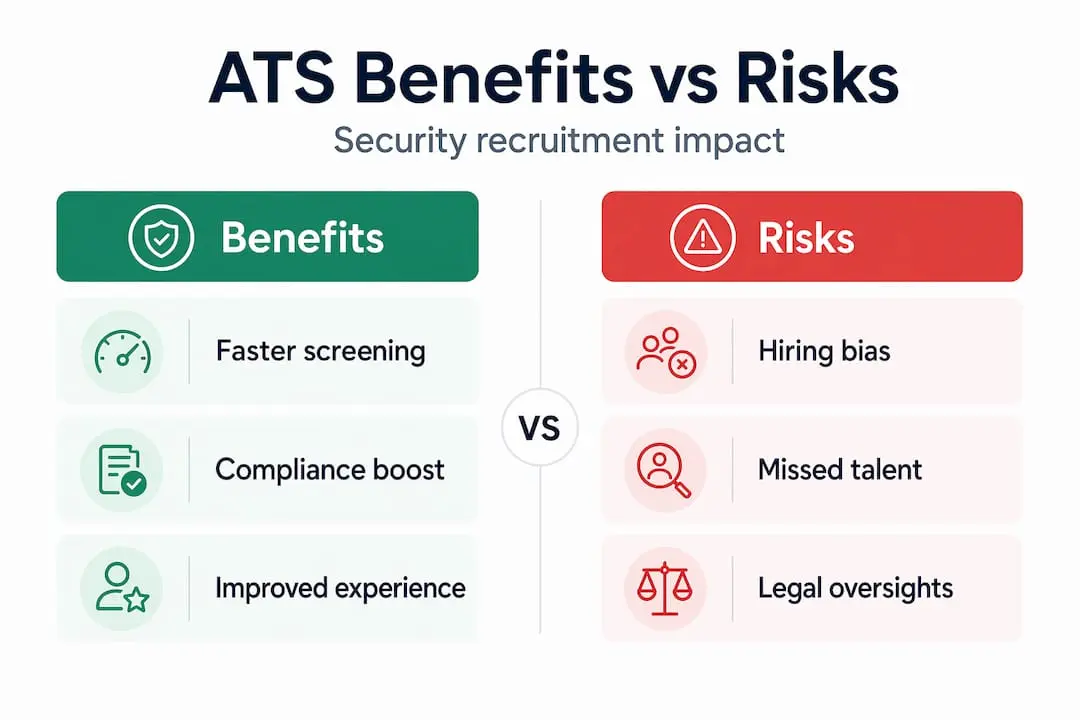
ATS reduce time spent on administrative tasks, improve candidate experience and compliance, and accelerate hiring of suitable candidates. For security employers, these gains are tangible.

| Benefit | What it means in practice |
|---|---|
| Faster screening | Filter 200 CVs down to 20 viable candidates in minutes rather than hours |
| Consistent process | Every applicant goes through the same defined steps, reducing ad hoc decisions |
| Audit trail | Records of who applied, when, and what decisions were made — vital for compliance |
| Improved candidate communication | Automated status updates reduce candidate drop-off and ghost-hunting |
| Centralised data | All application history in one place, accessible by your whole hiring team |
Security recruitment is often high-volume and time-sensitive. A regional security firm covering multiple contracts might receive 300 applications in a week following a contract win. Without automated recruitment tools to handle the initial sort, that volume crushes a small HR team.
The risks you cannot ignore
Automated screening can inadvertently create hiring bias by filtering out qualified candidates who lack certain keywords or exact profiles. This is not theoretical. A former soldier applying for a close protection role might describe their experience in military language rather than security industry terminology. An ATS configured to look for “close protection operative” may never surface that candidate.
The same problem applies to candidates from non-traditional backgrounds — people who have moved into security from retail, hospitality, or emergency services. Their skills are transferable, but their CVs may not contain the keywords your filters expect.
The most common ATS risks in security hiring:
- Over-reliance on keyword matching that excludes strong candidates with non-standard CVs
- Auto-rejection of candidates who did not format their CV in a way the parser can read
- Screening criteria that inadvertently disadvantage certain demographic groups
- Losing good candidates to slow automated processes when faster competitors are calling them directly
Pro Tip: Use your ATS to manage and organise candidate data, but keep a manual review stage for borderline candidates. If someone clears your minimum criteria but scores just below your threshold, a recruiter’s eyes on that CV could surface exactly the person you need. Pair this with proven hiring tips for UK security recruiters to build a process that is both fast and fair.
Navigating UK legal requirements and ethical considerations for automated hiring decisions
Using an applicant tracking system in the UK is not just an operational decision — it carries legal obligations. Understanding these requirements is essential for any security employer handling personal data and making automated decisions about candidates.
Automated decision-making and UK law
The Information Commissioner’s Office (ICO) has been explicit. The ICO expects employers using automated decision-making (ADM) in recruitment to provide transparency, mitigate bias proactively, and allow candidates rights to recourse including human review.
Automated decision-making, in the context of an ATS, refers to any step where a system makes or significantly influences a decision about a candidate without meaningful human involvement. Auto-rejection on the basis of a keyword filter qualifies. Scoring and ranking that determines who is shortlisted qualifies. The ICO is clear that candidates must be told this is happening.
“Organisations should be clear with candidates about use of ADM, explain how it works, and allow candidates to challenge decisions and request human review.”
What you are legally required to do
- Inform candidates in your privacy notice that automated screening tools are in use
- Explain the criteria being applied and how the system works, in plain language
- Provide a route for candidates to contest automated decisions
- Offer human review for any candidate who requests it
- Monitor your ATS outputs regularly for signs of bias or unlawful discrimination
Security employers also operate under broader employment law and security compliance obligations, and ATS use intersects with those directly. The GDPR compliance obligations for UK employers mean every piece of candidate data your ATS stores must have a lawful basis, a defined retention period, and a clear deletion process.
Pro Tip: Create a short internal document mapping every automated decision point in your ATS to its legal basis. When a candidate contests a decision, you need to be able to explain it clearly and quickly. Recruiters who cannot answer “how was this candidate rejected?” are in a weak position with the ICO.
Implementing applicant tracking systems effectively for UK security recruitment
Understanding legal and ethical considerations is one thing. Knowing how to actually put an ATS to work in your security recruitment operation is another.
A practical implementation framework
The best applicant tracking software does not run on autopilot. A common pattern is using ATS as the system of record and applying structured screening combined with recruiter-controlled review for better speed and quality. That means defining exactly which stages are automated and which require a human decision.
Steps to implement ATS effectively in security recruitment:
- Map your recruitment pipeline first. Before configuring any software, write out every step from job posting to offer. Identify which steps are administrative (data collection, status updates) and which are decision points (shortlisting, interview selection, rejection).
- Set criteria based on genuine requirements. For security roles, this means SIA licence type, relevant experience, and geographical availability. Avoid proxy criteria (e.g., specific educational qualifications) that do not actually predict job performance.
- Build in a human review stage for borderline candidates. When using automated ranking or auto-reject screening, map hiring steps to data management versus automated decisions, ensuring a human review pathway for borderline cases.
- Test your filters before going live. Run a sample of past successful hires through your ATS settings. If strong performers would have been screened out, your criteria need adjusting.
- Review your security recruitment workflow periodically. Security roles evolve. A filter set for a static guarding contract may not suit a retail security or CCTV operator role.
Practical measures to protect candidate experience:
- Set up automatic acknowledgement emails within one hour of application
- Send status updates at every stage change, even if the message is simply “your application is under review”
- Ensure your ATS is mobile-friendly, as most security candidates apply via smartphone
- Follow the principles outlined in guidance on improving candidate experience in security recruitment
Pro Tip: Revisit your ATS keyword filters every time you open a new type of role. The language used in a control room operator CV looks nothing like a mobile patrol officer’s CV. Using the same filter set across all roles is one of the most common and avoidable mistakes security employers make. A dedicated guide on streamlining security CV screening can help you build role-specific criteria from the ground up.
Rethinking automation: why human judgement remains essential in security hiring
Here is the uncomfortable truth that most ATS vendors will not say directly: the features of ATS that save the most time are also the ones most likely to cause you problems if you treat them as decisions rather than signals.
Automation accelerates your pipeline. It does not improve your judgement — it amplifies it. If your criteria are good, automation helps you find more of the right people faster. If your criteria are flawed, automation finds more of the wrong people faster, and rejects the right ones at scale. The algorithm does not know that the candidate who listed “event safety marshal” on their CV is actually a highly experienced door supervisor who never learned the industry terminology. A recruiter who reads that CV for 45 seconds does.
There is also a reputational dimension here that security employers often underestimate. Candidates talk. A qualified individual who receives an automated rejection with no explanation — or worse, no response at all — will share that experience. In a sector where word-of-mouth drives a significant portion of candidate referrals, a poor automated process actively damages your talent pipeline over time.
The employers who use integrated hiring software most effectively treat ATS data as the starting point of a conversation, not the end of one. They use it to surface candidates, then apply human assessment to understand them. That combination is faster than purely manual recruitment and fairer than purely automated recruitment.
Pro Tip: Use your ATS reporting to track where candidates drop out of your pipeline. If you are losing 60% of applicants between application and first contact, the problem is likely your response time, not your candidate pool. Data tells you where to look; a recruiter decides what to do about it. Visit our proven hiring tips for UK security recruiters for further guidance on building a process that keeps strong candidates engaged.
Simplify your security recruitment with Security Jobs Board
Putting the principles in this article into practice requires the right tools and the right platform behind them. Security Jobs Board is built specifically for UK security employers, offering an applicant tracking solution designed around the compliance, vetting, and candidate management challenges unique to this sector.

Security Jobs Board gives you a centralised candidate management system, targeted job postings that reach verified security professionals across the UK, and an employer dashboard built for speed and GDPR compliance. Whether you are hiring door supervisors in London or filling security jobs in Northern Ireland, the platform connects you with candidates who are actively looking for roles in your sector. You get the efficiency of automated recruitment tools without losing the human control that security hiring demands.
Frequently asked questions
What is an applicant tracking system?
An applicant tracking system is recruiting software used to collect and store candidate information, organise candidates through the hiring pipeline, and filter applicants using criteria the hiring team defines.
How does automated decision-making affect UK security recruitment?
Automated decision-making can speed up recruitment significantly, but UK employers must provide transparency, monitor for bias, and give candidates the right to request human review of automated outcomes as required by the ICO.
Can using an ATS lead to hiring bias?
Yes. ATS keyword reliance can unintentionally exclude qualified candidates with non-standard CVs or different professional backgrounds, which is why human review at key stages is essential.
How can I ensure my ATS use complies with UK data protection laws?
Confirm a Data Processing Agreement is in place with your ATS vendor, define data retention periods, and ensure candidates are informed of how their data is used and their right to request deletion or contest decisions.


