Cyber security career path certification guide

TL;DR:
- Building foundational IT knowledge is essential before pursuing security certifications, as it enhances employer relevance.
- Choosing certifications aligned with specific cybersecurity roles and gaining practical experience accelerate career advancement.
Choosing the right cyber security career path certification can feel genuinely confusing when you are starting out. There are dozens of credentials, dozens of opinions, and very little clarity on what actually gets you hired. Many newcomers assume that passing one exam is enough. The reality is more nuanced. A successful career in cyber security depends on building foundational knowledge first, choosing certifications that match your target role, and understanding exactly what employers are looking for at each stage of your journey. This guide cuts through the noise.
Table of Contents
- Key takeaways
- The cyber security career path: where it actually starts
- Types of cyber security certifications and what they signal
- Certification costs and realistic preparation timelines
- How education and certifications work together
- Building your certification plan step by step
- My honest take on certifications and career planning
- Start your cyber security career with Securityjobsboard
- FAQ
Key takeaways
| Point | Details |
|---|---|
| Build foundations first | Networking and OS knowledge are prerequisites that make certifications far more meaningful to employers. |
| Match certifications to your role | Entry, intermediate, and advanced credentials serve different career stages and specialisations. |
| Budget realistically | Total certification costs including materials and potential retakes can reach £1,500 or more. |
| Combine education and credentials | Professionals holding both a degree and certifications advance faster and earn significantly more over time. |
| Use UK market data | Aligning your certification choices with actual UK job requirements shortens the path to employment. |
The cyber security career path: where it actually starts
Before choosing any certification, you need to understand what the role landscape looks like. Cyber security is not a single job. It is a broad field with distinct tracks, and the certification that works brilliantly for one path may be irrelevant for another.
The main categories you will encounter include:
- SOC analyst (Security Operations Centre): monitoring alerts, responding to incidents, analysing threats in real time
- Penetration tester: ethically attacking systems to find vulnerabilities before criminals do
- GRC specialist (Governance, Risk and Compliance): ensuring organisations meet regulatory and policy requirements
- Cloud security engineer: securing cloud infrastructure across platforms like AWS, Azure, and Google Cloud
- Threat intelligence analyst: researching attacker behaviour, tracking threat actors, and producing intelligence reports
Each of these paths has different certification requirements, different salary trajectories, and different day-to-day demands. Choosing a certification before choosing a direction is a bit like booking a train without knowing which city you are travelling to.
Foundational IT knowledge sits underneath all of these tracks. You need a working understanding of networking (TCP/IP, DNS, firewalls), operating systems (particularly Linux and Windows), and basic scripting concepts. Skipping IT fundamentals and rushing straight into certifications is one of the most common mistakes career changers make. The result is passing an exam without actually understanding the concepts, which becomes obvious the moment you sit in a technical interview.
The journey from career changer to employed professional typically takes 6 to 18 months, depending on your prior knowledge and how many hours per week you can dedicate to study. That is a realistic and encouraging timeline for anyone prepared to commit.
Pro Tip: Before investing in any exam voucher, spend four to six weeks completing free networking fundamentals on platforms like Cisco Skills for All or Professor Messer’s CompTIA Network+ course. The clarity this gives you on later certification material is worth more than any shortcut.
Types of cyber security certifications and what they signal
Understanding the types of cyber security certifications and where they fit in your career is one of the most practical things you can do early on. The table below maps the main credentials to their level, focus, and typical use case.
| Certification | Level | Focus area | Best suited for |
|---|---|---|---|
| CompTIA Security+ | Entry | Broad security fundamentals | SOC analysts, IT staff moving into security |
| Cisco CyberOps Associate | Entry | Security operations monitoring | SOC analyst roles, network-oriented candidates |
| CompTIA CySA+ | Intermediate | Threat analysis and detection | Mid-level SOC, blue team specialists |
| CompTIA PenTest+ | Intermediate | Penetration testing methodology | Junior pentesters, offensive security roles |
| CEH (Certified Ethical Hacker) | Intermediate | Ethical hacking techniques | Pentesters, security consultants |
| CISSP | Advanced | Security management and architecture | Senior security managers, architects |
| CCSP | Advanced | Cloud security architecture | Cloud security engineers and architects |
| CISM | Advanced | Information security management | Security managers, compliance leads |
| CCISO | Executive | C-suite security leadership | CISOs and aspiring security executives |
There is a meaningful split between technical certifications and leadership certifications that many people overlook when planning their path to cyber security. CompTIA Security+, CySA+, and PenTest+ are fundamentally hands-on credentials. CISSP, CISM, and CCISO are more strategic. Moving from one category to the other is not automatic. Many technically brilliant professionals stall at mid-level roles because they never developed the governance and management knowledge that leadership certifications formalise.
One detail worth understanding is the compliance angle. Security+ satisfies IAT Level II for DoD work roles under the US DoD 8140 framework. This matters even in the UK context because many multinational employers and defence contractors require compliance-aligned credentials. Knowing this can give you a competitive edge when applying.
Industry demand for cloud security and AI-related skills is growing rapidly, which means CCSP and newer AI-focused credentials are increasing in employer priority across 2026 job listings.
Certification costs and realistic preparation timelines
One of the biggest mistakes people make when planning their cyber security certifications is underestimating what the total investment actually looks like.
The CompTIA Security+ exam costs approximately $425 USD with renewal fees of around $150 every three years. That is just the exam fee. Add study materials, practice lab subscriptions, and a prep course, and your total certification spend can reach £1,500 to £2,000 or more, particularly if you need to retake. CompTIA requires you to pay the full exam fee again on a retake, so thorough preparation is not optional.
Here is a realistic breakdown of preparation time for the most common certifications:
| Certification | Recommended prep time | Study hours per week |
|---|---|---|
| CompTIA Security+ | 2 to 3 months | 8 to 12 hours |
| Cisco CyberOps Associate | 3 to 4 months | 10 to 14 hours |
| CompTIA CySA+ | 3 to 4 months | 10 to 15 hours |
| CEH | 4 to 6 months | 12 to 16 hours |
| CISSP | 6 to 12 months | 15 to 20 hours |
Hands-on practice makes a decisive difference at every level. Platforms like TryHackMe and Hack The Box are genuinely useful for building the lab experience that makes certification concepts stick. Employers consistently report that candidates who can discuss real scenarios during interviews perform better than those who have memorised study notes.

Pro Tip: Buy exam vouchers through official channels and wait for discount periods. CompTIA regularly offers 10 to 15% discounts for students and early purchase windows. That saving alone can cover the cost of a quality practice exam package.
How education and certifications work together
There is a persistent debate in the cyber security community about whether a degree or certifications matter more. The honest answer is that they do different things, and the strongest candidates have both.
Certifications validate compressed, job-ready skills but do not replace the depth of understanding that a degree builds over time. A degree teaches you how to think systematically about problems. A certification teaches you how to pass a specific standard an employer recognises. Neither cancels the other out.
For entry-level roles, certifications carry significant weight. Many entry-level roles accept Security+ without requiring a degree, particularly for SOC analyst positions. This is genuinely good news if you are career-changing into security without a computing background.
The financial case for combining both credentials is compelling:
- Professionals who hold both a degree and certifications advance faster and earn 15 to 30% more across their careers
- Advanced certifications like CISSP, CCSP, and CISM can boost salaries by 10 to 20% in 2026
- Stacking credentials strategically unlocks promotions, particularly once you move beyond entry level
- At executive level, 100% of surveyed CISOs recommend executive-level certifications for those aspiring to senior leadership
The direction of travel as your career matures is also worth understanding. Junior roles reward technical certifications. Mid-level roles reward a combination of technical depth and process knowledge. Senior and executive roles reward governance, risk management, and now increasingly, AI threat readiness. Planning your certification sequence with that trajectory in mind from the start puts you ahead of most candidates. You can explore how this plays out in practice with Securityjobsboard’s guide to career paths in security for a broader view.
Building your certification plan step by step
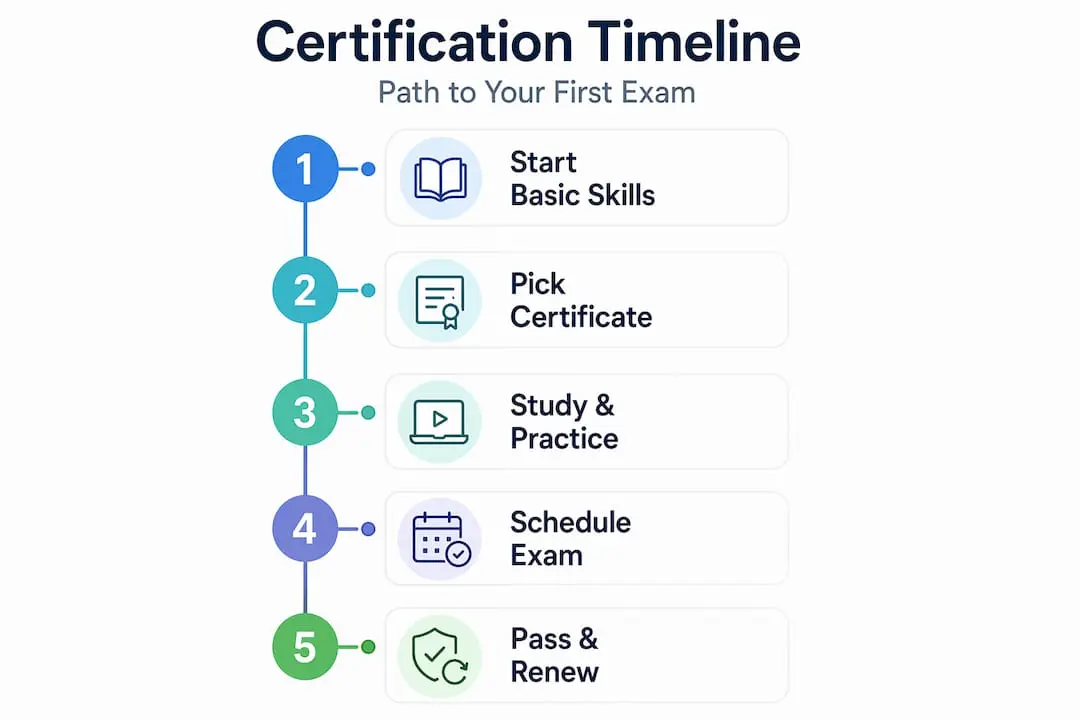
Knowing which certifications exist is one thing. Turning that knowledge into a personal plan you will actually follow is another. Here is a practical sequence that works for most people entering the field.
- Assess your starting point. If you have an IT background, you may be ready for Security+ within two to three months. If you are coming from a completely unrelated field, budget four to six months for IT fundamentals first.
- Choose your track early. Decide whether you are drawn to defensive security (blue team), offensive security (red team), or governance and compliance. This choice determines your certification sequence from the outset.
- Start with Security+ or CyberOps Associate. Both are widely recognised by UK employers and provide enough breadth to explore your direction before committing to a specialisation.
- Build a practical portfolio alongside study. Complete capture-the-flag (CTF) challenges, document your lab work on GitHub, and write up what you learn. Employers in the UK market weight evidence of practical skill very highly. Securityjobsboard’s advice on improving security employability covers this well.
- Engage with the professional community. Join UK-based groups such as CIISec (Chartered Institute of Information Security) and attend local meetups. The people you meet at these events often know about roles before they are advertised.
- Stack certifications with purpose. After your entry-level credential, move to a specialisation certificate within twelve months. Avoid collecting unrelated certifications simply to pad a CV. Targeted stacking is what boosts salary progression in the UK market.
- Check live job listings regularly. The best way to calibrate your certification choices is to read what employers are actually asking for. The 2026 UK security job market outlook gives a clear picture of where demand is concentrated.
My honest take on certifications and career planning
I have spoken with a lot of cyber security professionals over the years, and the ones who build genuinely rewarding careers share one trait: they treat certifications as signposts, not destinations.
The certification gets you through the application filter. What keeps you in the role and moves you forward is foundational knowledge, intellectual curiosity, and the ability to communicate complex problems clearly to non-technical colleagues. Soft skills like communication and calm under pressure consistently separate people who plateau from people who progress. I have seen technically excellent candidates stall at mid-level for years because they could not explain a risk to a board. I have also seen people with modest technical credentials reach senior positions because they understood governance and could hold a room.
What I find most interesting about 2026 is the shifting expectations at executive level. AI threat readiness and enterprise governance are now baseline requirements for senior security leadership, not differentiators. If you are planning a long career in this field, start developing that mindset early, even while you are still studying for Security+.
My advice is simple. Invest in the foundations. Choose one track. Get your first certification with genuine understanding rather than a cramming sprint. Then build on it deliberately.
— Rob
Start your cyber security career with Securityjobsboard
You have the knowledge. Now you need to connect it to real opportunities in the UK market.

Securityjobsboard is the UK’s specialist platform for security industry roles, and cyber security positions are among the fastest-growing listings on the site. Whether you have just passed your first certification or you are ready to step into a senior security role, you will find relevant vacancies and genuine career advice for security professionals that matches where you are in your journey. If you are based in, or open to opportunities across, Northern Ireland, explore the current security jobs in Northern Ireland listings to see what employers in that market are asking for right now.
FAQ
What is the best entry-level cyber security certification?
CompTIA Security+ is the most widely recognised entry-level credential among UK and international employers. It covers broad security fundamentals and is accepted by many organisations as the baseline for SOC analyst and junior security roles.
Do I need a degree to start a cyber security career?
Not necessarily. Many entry-level roles, particularly SOC analyst positions, accept certifications like Security+ in place of a degree. However, combining a degree with certifications significantly improves long-term earning potential and career progression speed.
How much does a cyber security certification cost in total?
The CompTIA Security+ exam costs approximately $425 USD, but total costs including study materials, practice labs, and potential retakes can reach £1,500 to £2,000 or more. Budgeting for the full investment from the start avoids unpleasant surprises.
Which cyber security certification pays the most?
Advanced credentials such as CISSP, CCSP, and CISM are consistently linked to the highest salaries. These certifications can boost earnings by 10 to 20% in 2026, particularly when combined with relevant experience and a degree-level qualification.
How long does it take to get a cyber security job after starting certifications?
The path from career changer to employed cyber security professional typically takes 6 to 18 months, depending on prior IT knowledge and weekly study hours. Combining practical lab work with certification study shortens this timeline considerably.


