
Security personnel often navigate their duties alone in a range of environments, from empty office buildings at night to remote locations far from immediate help. For managers in United Kingdom firms, ensuring these employees are protected is more than a legal obligation—it is a key part of effective risk management. A lone working policy creates a solid safety foundation, helping to reduce uncertainty and support continuous employee wellbeing.
Table of Contents
- Lone Working Policy Defined for Security
- Types of Lone Working in the Sector
- Legal Requirements and Industry Standards
- Risk Assessment and Control Measures
- Employer and Employee Duties Explained
- Common Pitfalls and How to Avoid Them
Key Takeaways
| Point | Details |
|---|---|
| Lone Working Policy Importance | Establishing a robust lone working policy is essential for ensuring the safety and wellbeing of security personnel working independently. |
| Legal Framework Compliance | adherence to the Health and Safety at Work Act 1974 and the Management of Health and Safety at Work Regulations 1999 is crucial for legal compliance and worker protection. |
| Risk Assessment Necessity | Conducting thorough, ongoing risk assessments is vital to identify and mitigate potential hazards specific to lone working environments. |
| Shared Responsibilities | Both employers and employees play critical roles in maintaining safety; effective communication and training are key components for success. |
Lone Working Policy Defined for Security
A lone working policy represents a comprehensive safety framework designed to protect security personnel who perform duties independently or without direct supervision. Lone worker policies fundamentally define workers who operate separately from colleagues, potentially in varied environments such as isolated buildings, external locations, or during non-standard working hours.
The core objective of such policies is managing potential risks associated with solitary work. Security professionals working alone face unique challenges including personal safety, communication barriers, and emergency response limitations. These policies establish clear protocols to mitigate potential hazards by outlining specific responsibilities, communication strategies, and risk assessment procedures. Safety management guidelines emphasise proactive planning to ensure worker protection.
Key components of an effective lone working policy typically include:
- Comprehensive risk assessments for different work scenarios
- Precise emergency communication protocols
- Personal safety equipment requirements
- Regular safety training and awareness programmes
- Documented check-in and tracking mechanisms
- Clear escalation procedures for potential security threats
Professional Tip: Implement a robust digital check-in system that automatically alerts designated emergency contacts if a lone security worker fails to confirm their status during scheduled intervals.
Types of Lone Working in the Sector
Secure professional environments recognise multiple categories of lone working that reflect the diverse nature of security sector employment. Lone worker environments encompass several distinct operational contexts, each presenting unique safety considerations and risk management challenges.
Typical lone working categories in the security sector include fixed base workers, mobile professionals, and external site operatives. Fixed base workers operate independently within a single establishment, often during non-standard hours or in isolated sections of larger facilities. Mobile security professionals, such as mobile patrol officers or security consultants, travel between multiple locations and frequently work without direct supervision. External site operatives might include security personnel stationed at construction sites, event venues, or remote infrastructure locations.
The classification of lone workers depends on several critical factors:
- Physical work location (fixed site vs mobile)
- Frequency of human interaction
- Duration of solitary work periods
- Complexity of potential risk environments
- Communication infrastructure availability
Security worker classifications demonstrate that each category requires tailored risk assessment strategies and specialised safety protocols to protect personnel effectively.

Below illustrates how lone working categories differ in the security sector:
| Lone Working Category | Typical Environments | Primary Safety Challenge |
|---|---|---|
| Fixed Base Worker | Offices, warehouses | Isolation during night hours |
| Mobile Professional | Multiple sites, vehicles | Limited contact and oversight |
| External Site Operative | Construction, event locations | Exposure to environmental risks |
Professional Tip: Develop role-specific safety protocols that account for the unique characteristics of each lone working category, ensuring targeted risk mitigation approaches.
Legal Requirements and Industry Standards
The legal landscape governing lone worker safety in the security sector is comprehensive and stringent, establishing clear responsibilities for both employers and employees. Health and safety regulations mandate specific protective measures to ensure worker protection and minimise potential risks associated with solitary work environments.
Two primary legislative frameworks form the backbone of lone worker safety standards in the United Kingdom. The Health and Safety at Work Act 1974 and the Management of Health and Safety at Work Regulations 1999 place explicit legal obligations on employers to conduct thorough risk assessments, implement robust control mechanisms, and provide comprehensive training for lone workers. These regulations require organisations to develop detailed safety protocols that address potential hazards specific to individual working environments and job roles.
Key legal requirements for lone worker protection include:
- Comprehensive risk assessment procedures
- Documented safety management systems
- Regular safety training programmes
- Effective communication and monitoring protocols
- Emergency response and incident reporting mechanisms
- Provision of appropriate personal safety equipment
Employer safety obligations emphasise that legal compliance is not merely a box-ticking exercise but a fundamental commitment to protecting personnel in potentially vulnerable working situations.
Professional Tip: Develop a comprehensive lone worker policy that exceeds minimum legal requirements, demonstrating proactive commitment to employee safety and organisational risk management.
Risk Assessment and Control Measures
Risk assessment represents a crucial foundation for protecting lone workers in the security sector, involving systematic identification and mitigation of potential workplace hazards. Comprehensive risk evaluation requires a nuanced approach that considers multiple dimensions of worker vulnerability and environmental challenges.
The risk assessment process encompasses several critical stages of analysis. Security organisations must thoroughly examine potential physical, environmental, and psychological risks specific to individual roles and working contexts. This involves detailed scrutiny of work locations, potential interaction points with threats, communication infrastructure, and individual worker capabilities. Employers must develop dynamic assessment frameworks that can adapt to changing workplace conditions and emerging security challenges.
Key components of an effective risk assessment strategy include:
- Detailed mapping of potential workplace hazards
- Individual worker capability and medical fitness evaluations
- Environmental risk factor identification
- Communication and emergency response planning
- Regular reassessment and policy updating mechanisms
- Technological monitoring and support systems
Lone worker safety protocols emphasise that risk control is an ongoing process requiring continuous monitoring, training, and adaptive management strategies.
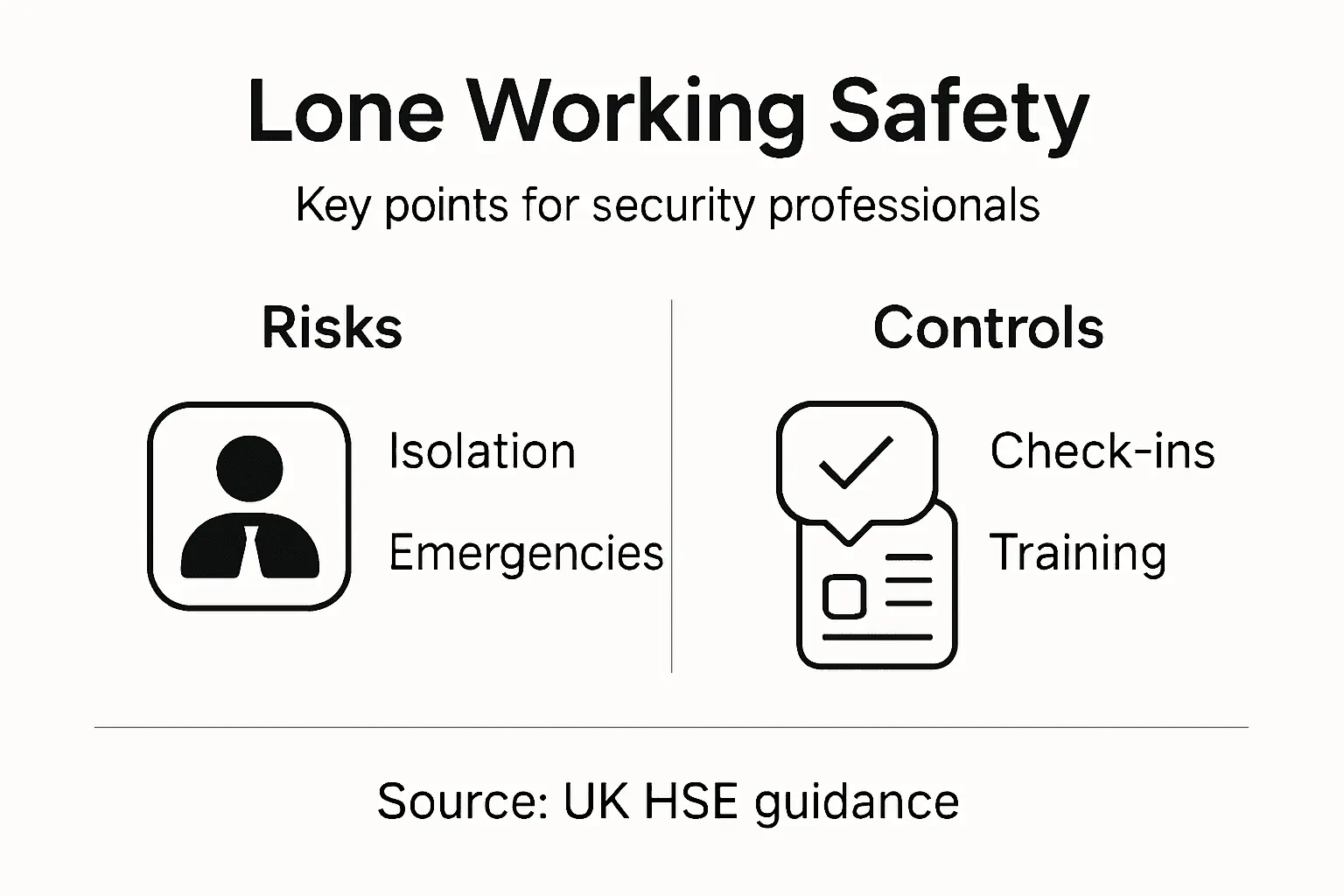
Professional Tip: Create a standardised risk assessment template that can be quickly customised for different security roles, enabling rapid and consistent evaluation of potential workplace vulnerabilities.
Employer and Employee Duties Explained
The landscape of lone working safety is built upon a foundation of shared responsibilities between employers and security personnel. Employer safety obligations require a comprehensive and proactive approach to managing potential workplace risks and ensuring worker protection.
Employers bear the primary responsibility for establishing robust safety frameworks. This includes conducting thorough risk assessments, developing clear safety protocols, providing appropriate training and equipment, and creating effective communication and emergency response systems. They must design policies that address the unique challenges of lone working, considering factors such as individual worker capabilities, environmental risks, and potential threat scenarios specific to security roles.
Key duties for both employers and employees include: Employer Responsibilities:
- Comprehensive risk assessment and management
- Providing safety training and resources
- Establishing clear communication protocols
- Implementing emergency response mechanisms
- Regular policy review and updates
Employee Responsibilities:
- Following established safety procedures
- Reporting potential hazards
- Maintaining open communication
- Using provided safety equipment
- Participating in safety training
Workplace safety guidelines emphasise that effective lone worker protection requires a collaborative and proactive approach from all parties involved.
Here’s a summary highlighting employer responsibilities versus employee duties for lone worker safety:
| Duty Type | Example Responsibility | Importance for Safety |
|---|---|---|
| Employer | Develop training programmes | Ensures preparedness |
| Employer | Provide monitoring systems | Supports rapid emergency response |
| Employee | Report safety concerns | Identifies hazards quickly |
| Employee | Use protective equipment correctly | Reduces injury risk |
Professional Tip: Develop a culture of shared safety responsibility through regular collaborative discussions and transparent communication about potential workplace risks and mitigation strategies.
Common Pitfalls and How to Avoid Them
Lone working in the security sector presents numerous potential hazards that require strategic, proactive management. Personal safety challenges emerge from complex interactions between individual worker capabilities, environmental risks, and organisational preparedness.
The most prevalent pitfalls stem from systemic weaknesses in risk assessment and communication protocols. Security organisations frequently underestimate the nuanced vulnerabilities associated with solitary work environments. These vulnerabilities include inadequate emergency response planning, insufficient technology-enabled monitoring, poor communication infrastructure, and limited worker training on potential threat scenarios. Comprehensive risk management demands a holistic approach that addresses both technical and human factors.
Critical pitfalls to avoid include:
- Superficial risk assessments
- Inadequate communication systems
- Insufficient worker training
- Neglecting regular policy updates
- Failing to implement technological monitoring solutions
- Overlooking individual worker psychological preparedness
Lone worker safety strategies emphasise the importance of developing adaptive, responsive safety frameworks that evolve with changing workplace dynamics.
Professional Tip: Conduct quarterly comprehensive reviews of lone worker safety protocols, integrating feedback from frontline security personnel to identify and mitigate emerging vulnerabilities.
Secure Your Lone Working Role with Confidence
The challenges of lone working in the security sector demand safety-first solutions that put your wellbeing at the forefront. If you are a security professional seeking roles that prioritise robust lone working policies and emphasise clear risk assessment and communication protocols, then finding the right employer is crucial. Our platform supports your goals by connecting you with organisations committed to exceeding legal standards and ensuring comprehensive worker protection.

Discover a broad range of security positions tailored to lone workers on the Security Jobs Board. Whether you are looking for fixed base, mobile, or external site roles, our user-friendly site allows you to upload CVs, set job alerts and apply directly to employers who value safety as much as you do. Take control of your career in a secure environment. Visit Security Jobs Board now and find your next opportunity where your safety is a priority.
Frequently Asked Questions
What is a lone working policy?
A lone working policy is a comprehensive safety framework designed to protect security personnel who perform their duties independently or without direct supervision, focusing on managing the risks associated with solitary work.
What are the key components of an effective lone working policy?
Key components include comprehensive risk assessments, emergency communication protocols, personal safety equipment requirements, regular safety training, documented check-in mechanisms, and clear escalation procedures for security threats.
What legal requirements must employers follow for lone worker safety?
Employers must adhere to the Health and Safety at Work Act 1974 and the Management of Health and Safety at Work Regulations 1999, which mandate thorough risk assessments, training, emergency response plans, and safe working practices for lone workers.
How can employers avoid common pitfalls in lone working safety?
Employers can avoid pitfalls by conducting thorough risk assessments, ensuring robust communication systems, providing adequate training, updating policies regularly, and implementing monitoring technology to support lone workers.


