
Security professionals across the United Kingdom face increasing pressure to keep pace with rapidly evolving digital threats. As organisations embrace hybrid and remote working, remote monitoring has become a vital tool for detecting risks and protecting critical assets from cyber attacks and unauthorised access. Mastering these advanced monitoring technologies not only helps safeguard confidential information but also opens new career pathways in one of the most dynamic areas of the security sector.
Table of Contents
- Defining Remote Monitoring in Security Roles
- Core Types of Remote Monitoring Systems
- How Remote Monitoring Systems Operate
- Legal Standards and Compliance in the UK
- Employment Opportunities and Professional Skills
Key Takeaways
| Point | Details |
|---|---|
| Importance of Remote Monitoring | Remote monitoring is essential for identifying and mitigating cybersecurity risks in real-time across organisational networks. |
| Types of Monitoring Systems | Key remote monitoring systems include Network Monitoring, Video Surveillance, and Sensor-Based Monitoring, each serving distinct security functions. |
| Legal Compliance | Compliance with legal standards such as the Data Protection Act and GDPR is crucial for maintaining security and protecting sensitive information. |
| Career Development | Careers in remote monitoring require continuous learning and the development of both technical and analytical skills to adapt to evolving security challenges. |
Defining Remote Monitoring in Security Roles
Remote monitoring in security represents a sophisticated approach to tracking, analysing, and protecting organisational systems and networks from potential threats. At its core, this process involves continuously observing digital environments to detect, assess, and respond to security incidents in real-time.
The fundamental purpose of remote monitoring is to collect and analyse security event data across an organisation’s technological infrastructure. This comprehensive strategy enables security professionals to:
- Identify potential cybersecurity risks
- Track unusual network activities
- Monitor system vulnerabilities
- Escalate critical incidents quickly
- Implement proactive defensive measures
In practical terms, remote monitoring requires professionals to leverage advanced technological tools and techniques. Security experts utilise sophisticated platforms like Security Information and Event Management (SIEM) systems, network analysis software, and automated monitoring processes to maintain continuous surveillance.
Remote monitoring transforms reactive security approaches into proactive defence strategies, allowing organisations to anticipate and mitigate potential threats before they escalate.
Professionals in this field must understand the complex risks associated with remote working and information handling. They need comprehensive skills in cybersecurity, data analysis, and rapid incident response to effectively protect digital assets.
Pro tip: Develop a robust understanding of multiple monitoring technologies and stay updated with the latest cybersecurity trends to enhance your remote monitoring expertise.
Core Types of Remote Monitoring Systems
Remote monitoring systems represent sophisticated technological solutions designed to collect, track, and analyse critical security data without direct physical presence. These advanced systems have evolved to address complex security challenges across various professional environments.
In sensitive operational contexts, remote sensing technologies enable data collection with minimal human intervention. The primary categories of remote monitoring systems include:
- Network Monitoring Systems
- Track digital traffic and communication patterns
- Detect unusual network activities
- Identify potential cybersecurity breaches
- Video Surveillance Systems
- Provide real-time visual monitoring
- Enable remote observation of physical spaces
- Record and archive visual evidence
- Sensor-Based Monitoring Systems
- Utilise environmental and motion sensors
- Monitor physical access points
- Generate immediate alerts for unauthorized entries
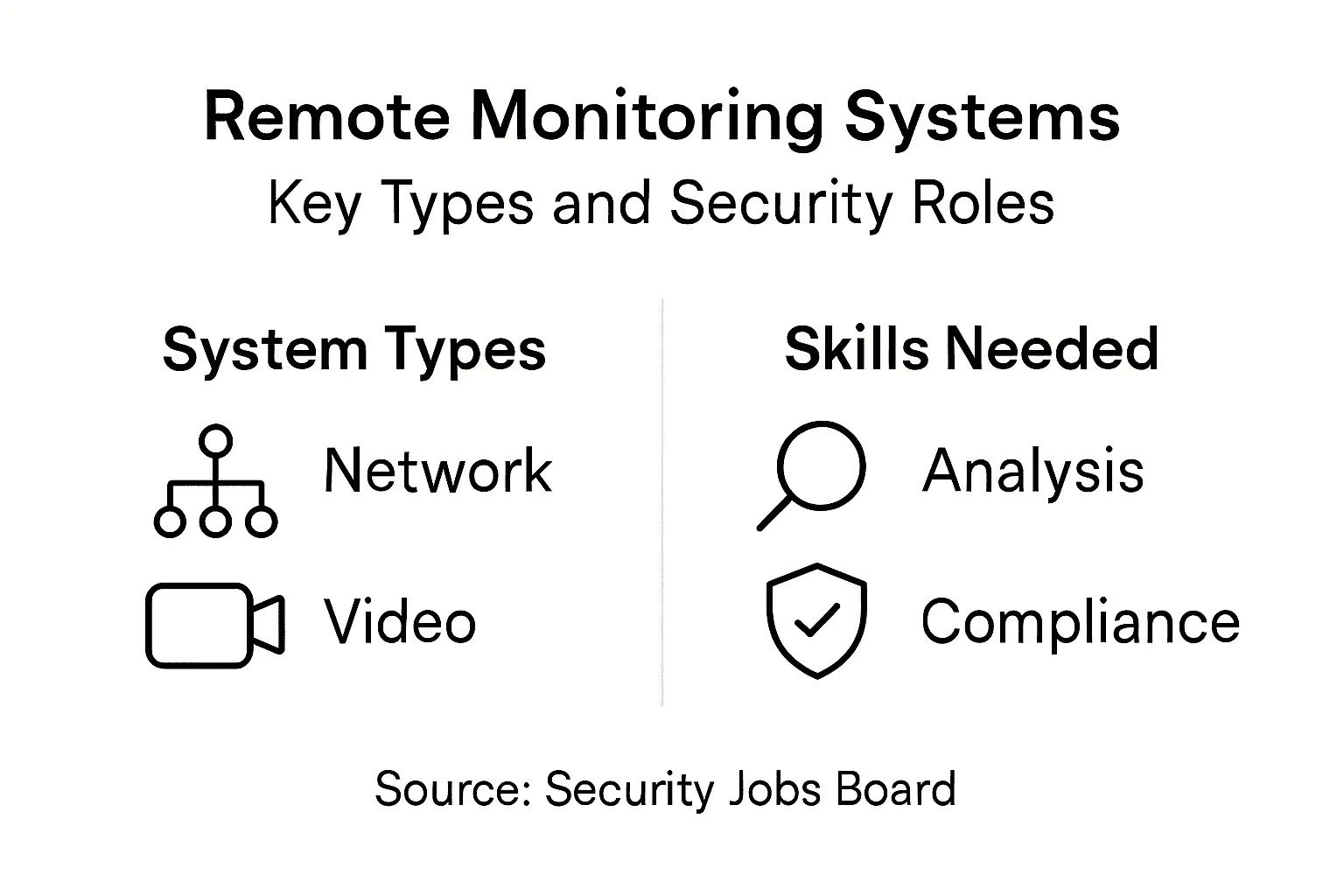
Each monitoring system type serves distinct security objectives, leveraging unique technological capabilities to provide comprehensive protection. Network monitoring focuses on digital infrastructure, video systems offer visual surveillance, and sensor-based solutions track physical movements and access.
Here is a comparison of the main types of remote monitoring systems and their ideal applications:
| System Type | Key Focus | Ideal Use Case |
|---|---|---|
| Network Monitoring | Digital infrastructure | Detect cyber threats remotely |
| Video Surveillance | Visual observation | Monitor physical premises |
| Sensor-Based Monitoring | Access and environment | Secure sensitive access points |
Remote monitoring technologies transform traditional security approaches by enabling continuous, intelligent surveillance across multiple operational domains.
The integration of these systems requires advanced technological expertise, combining cybersecurity knowledge, data analysis skills, and understanding of complex monitoring infrastructures. Security professionals must develop nuanced abilities to interpret and respond to the diverse data streams generated by these sophisticated monitoring platforms.
Pro tip: Invest in continuous learning about emerging remote monitoring technologies to stay ahead in the rapidly evolving security landscape.
How Remote Monitoring Systems Operate
Remote monitoring systems function through a complex, interconnected network of technological processes designed to capture, analyse, and respond to security events across digital and physical environments. These sophisticated systems continuously gather and interpret data from multiple sources, creating a comprehensive security intelligence framework.
Security monitoring involves collecting detailed information from various critical infrastructure points. The operational mechanism typically includes several key stages:
- Data Collection
- Gather logs from network devices
- Capture endpoint activity records
- Aggregate information from multiple sensors
- Data Aggregation
- Centralise collected information
- Standardise data formats
- Prepare for comprehensive analysis
- Threat Detection
- Compare incoming data against established baselines
- Identify potential security anomalies
- Generate immediate threat alerts
The core technological infrastructure relies on advanced algorithms and machine learning techniques to distinguish between normal operational patterns and potential security breaches. These intelligent systems can rapidly process massive volumes of data, identifying subtle indicators of potential threats that might escape human observation.
Effective remote monitoring transforms raw data into actionable security intelligence, creating a proactive defence mechanism that anticipates and neutralises potential risks.
Cybersecurity professionals must develop sophisticated skills to configure, interpret, and respond to the complex data streams generated by these monitoring platforms. This requires a deep understanding of network architecture, threat landscape dynamics, and advanced analytical methodologies.
Pro tip: Develop proficiency in data analysis and machine learning techniques to enhance your ability to interpret complex monitoring system outputs.
Legal Standards and Compliance in the UK
Legal compliance forms the cornerstone of effective remote monitoring in the United Kingdom’s security sector, establishing critical frameworks that protect both organisational and individual interests. Security professionals must navigate a complex landscape of regulatory requirements and ethical considerations to ensure comprehensive protection.
The UK Security Policy Framework sets comprehensive standards for protecting government and private sector assets. These legal standards encompass multiple critical dimensions of security practice:
- Information Protection
- Maintaining data confidentiality
- Ensuring information integrity
- Protecting sensitive operational details
- Personnel Security
- Conducting thorough background checks
- Managing insider threat risks
- Implementing robust vetting processes
- Operational Compliance
- Adhering to data protection regulations
- Following cybersecurity best practices
- Maintaining comprehensive audit trails
The regulatory landscape requires security professionals to balance technological capabilities with strict legal constraints. This demands a nuanced understanding of legislation such as the Data Protection Act, General Data Protection Regulation (GDPR), and sector-specific security guidelines.
This table summarises essential legal standards affecting remote monitoring in the UK:
| Legal Standard | Main Requirement | Sector Covered |
|---|---|---|
| Data Protection Act | Safeguard personal data | Public and private sectors |
| GDPR | Regulate data privacy | All organisations handling EU data |
| Security Policy Framework | Protect critical assets | Government and contractors |
Effective legal compliance transforms remote monitoring from a technical function into a strategic organisational safeguard, protecting critical assets and maintaining professional integrity.
Cybersecurity experts must continuously update their knowledge, understanding that legal standards are not static but evolve with technological advancements and emerging threat landscapes. This requires a proactive approach to learning and adapting to new regulatory requirements.
Pro tip: Regularly attend professional development workshops and maintain certifications to stay current with the latest legal and compliance standards in remote monitoring.
Employment Opportunities and Professional Skills
Remote monitoring careers in the United Kingdom represent a dynamic and rapidly expanding field within the security sector, offering professionals diverse pathways for career development and specialisation. The landscape of security monitoring jobs continues to evolve, driven by increasing technological complexity and emerging cyber threats.
Employment opportunities span multiple sectors, ranging from entry-level positions to advanced leadership roles in cybersecurity. The professional skills required for success in this field are multifaceted and continuously developing:
- Technical Competencies
- Advanced knowledge of cybersecurity tools
- Proficiency in SIEM platforms
- Network and endpoint monitoring expertise
- Analytical Skills
- Threat intelligence interpretation
- Incident response capabilities
- Strategic risk assessment
- Soft Skills
- Excellent communication
- Problem-solving abilities
- Adaptability to changing technologies
Security monitoring professionals must develop a comprehensive skill set that balances technical expertise with strategic thinking. This requires continuous learning and adaptability in a landscape where technological threats are constantly evolving.
Successful security monitoring careers are built on a foundation of technical excellence, continuous learning, and the ability to anticipate and mitigate emerging digital risks.
Career progression in remote monitoring typically involves transitioning from operational roles to more strategic positions, with opportunities for specialisation in areas such as threat intelligence, incident response, and security governance. Professionals who invest in ongoing certification and skill development will find themselves most competitive in this dynamic job market.
Pro tip: Pursue industry-recognised certifications like CISSP or CompTIA Security+ to enhance your marketability and demonstrate professional competence in remote monitoring roles.
Unlock Your Career in Remote Monitoring and Security
Remote monitoring is transforming the security industry with its demand for vigilant professionals skilled in cybersecurity tools, threat detection, and legal compliance. If you are eager to break into this fast-growing field or advance your career in roles that require expertise in network monitoring, video surveillance, and sensor-based systems this is your opportunity to connect with top employers. Whether your strength lies in analysing security events or responding swiftly to potential cyber threats, understanding these core concepts is key to career success.

Take control of your professional future by exploring tailored security jobs on the Security Jobs Board. Our platform offers you the fastest way to create a profile, upload your CV, and access relevant vacancies across the UK security sector. Don’t miss out on specialised positions that require your unique remote monitoring skills and knowledge. Visit https://www.securityjobsboard.co.uk/ now to find your next role and advance confidently in the security industry.
Frequently Asked Questions
What is remote monitoring in security?
Remote monitoring in security involves continuously tracking, analysing, and protecting organisational systems and networks from threats by observing digital environments in real-time.
What are the core types of remote monitoring systems?
The main types of remote monitoring systems include Network Monitoring Systems, Video Surveillance Systems, and Sensor-Based Monitoring Systems, each focusing on different security objectives such as digital traffic, visual observation, and physical access monitoring.
How do remote monitoring systems operate?
Remote monitoring systems operate by collecting data from various sources, aggregating that data, and then using advanced algorithms to detect potential security threats or anomalies, thereby enabling effective real-time responses.
What skills are needed for a career in remote monitoring?
Key skills for a career in remote monitoring include technical competencies in cybersecurity tools, strong analytical capabilities for threat interpretation, and soft skills like effective communication and problem-solving abilities.


